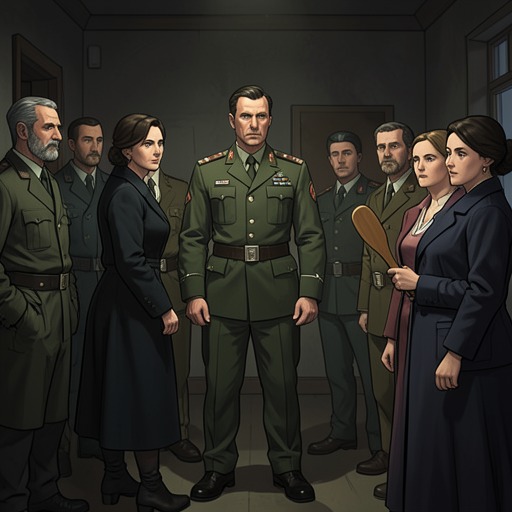
Dominic finds and rescues Isabel at the market
When You Were MineDominic finds and rescues Isobel at the market after he has already accepted that she is dead and is preparing to attend her burial. Their unexpected meeting in Melton Mowbray becomes an immediate test of recognition and trust: with Rupert Davenport close behind Isobel, Dominic must conceal his aid, help her escape the crowded town, and get her to safety despite her exhaustion and worsening exposure to the elements.
Grief and Recognition
Dominic rides through Melton Mowbray on market day after returning home briefly to deal with estate matters. He is due to leave for Willowbrook to witness Isobel’s interment in the family crypt. The ordinary business of the town—the market crowd, its animals, and traders calling out their wares—passes around him while he broods over her absence. His grief is physical as well as emotional, and he is struggling to continue home when he sees a cloaked figure approaching a bakery.
The sight first presents itself as an impossible hope. Dominic stops Brutus and watches, barely attending to the curious looks of the townspeople. He knows that the woman he loves cannot be buying bread in the village if she is dead, yet the figure’s movement is familiar enough to hold him there. Rather than dismiss the possibility and ride on, he dismounts and waits outside the bakery. When the cloaked woman reappears, the line of her chin confirms what reason had denied; then Isobel’s blue eyes meet his. The recognition reverses the emotional direction of the scene: the man who had been riding toward her burial is suddenly face to face with her alive.
A Rescue Concealed in Plain Sight
The reunion cannot become a private conversation. Isobel sees Rupert approaching and looks to Dominic in terror. She fears that he might betray her by handing her back to her uncle, which would undo the weeks she has spent trying to escape. Dominic reads her alarm without needing to turn around. He suppresses the questions he wants to ask and understands that, for the moment, protection requires a performance rather than an open confrontation.
He addresses Isobel as though she were a young male servant who has neglected duties assigned that morning. His stern reprimand gives her a plausible reason to leave, while his brief wink communicates what his words cannot: she must trust him and go. When she hesitates, uncertain of his intention, he gently pushes her toward the road and away from Rupert. Isobel then disappears into the market crowd. Dominic stays behind to face her uncle, controlling his anger and maintaining an outwardly cool manner rather than exposing the escape he has enabled.
The ruse makes the crowded market both a danger and a means of concealment. Isobel can vanish among its people, but her safety depends on getting beyond the town before Rupert finds her. Dominic hopes she will seek sanctuary at Havistock Hall, though he is not certain where she has gone. He tells Sanderson that she headed in that direction and that they must find her. Their search is brief: Sanderson spots movement in the woods less than a mile outside town.
Finding Isobel in the Woods
Dominic dismounts and goes after the figure himself, judging that Isobel may distrust Sanderson, whom she might mistake for one of Rupert’s men. He gives Sanderson Brutus’s reins and directs him to take the horse through the trees to a gate farther on, wait there, and watch for anyone following. Dominic’s urgency has two sources: he needs to reach Isobel before her uncle does, and he still needs to be certain that the woman he saw in the market was not an illusion born of grief.
Isobel is trembling and sick with exhaustion. During her flight she has dropped the bread she was carrying into the dirt, a small but telling sign of how little strength she has left. When a tall figure emerges silently from the trees, she tries to prepare herself to resist capture, but fear overwhelms her and her knees buckle. Dominic reaches her before she falls. He lifts her with striking ease, finding that she has scarcely enough strength to struggle, and she willingly sinks against him. His embrace and kiss on her forehead meet an immediate need for comfort after the terror of the pursuit; the rescue is not only her removal from danger, but the restoration of a trusted presence she had feared might turn against her.
The Journey to Havistock Hall
Dominic’s priority becomes getting Isobel to shelter. She is too depleted to manage the journey unaided, and he carries her as they leave the woods. In the encroaching darkness, they reach a small copse and encounter a stocky rider waiting on a large bay horse. The sight frightens Isobel, who is grateful not to have faced the rider alone while she was fleeing. She is lifted back against Dominic, and the horses canter across open fields toward Havistock Hall.
Isobel soon loses consciousness from exhaustion. Dominic wraps her in his long wool cloak and feels how cold her skin has become. He cannot determine whether starvation, cold, exhaustion, or fear caused her to faint, but the uncertainty only sharpens the need to reach the house quickly. He has already sent his groom to summon a doctor several miles back. Rain begins to fall before they arrive, worsening an already dangerous exposure.
At Havistock Hall, Dominic brings Isobel through the heavy oak doors into the warmth of the Main Hall. He calls urgently for the household staff and carries her upstairs, scarcely noticing the puddles left by his boots. The market encounter has carried the story from apparent bereavement to rescue, but its immediate outcome is not yet security in any lasting sense: Isobel reaches refuge in a perilously weakened condition and needs care. The scene’s decisive change is that Dominic’s grief gives way to action, while the woman he had thought lost is alive again—but still in danger and dependent on swift protection.